Pale Oak
OC-20 · Benjamin Moore


Benjamin Moore
Pale Oak
OC-20
Subtle yellow-beige, a warm color
- Color family
- White
- Sold for
- Interior and exterior
Benjamin Moore Pale Oak OC-20 is a light greige, a gray with just enough beige in it to stay soft. Its LRV of 69 sits near the top of the light band, bright enough to carry a room without turning into a white. It is one of the brand's most searched wall colors, used through open plans, hallways and bedrooms, and often on kitchen cabinets where a plain white would look hard.
Is Pale Oak warm or cool? Undertones by the numbers
leans yellow
Undertone
Subtle yellow-beige
A gentle lean, quiet on the wall.
The measurement puts a small, even dose of yellow in Pale Oak and effectively no red or green, which is why it can pass for a warm white in one room and a soft greige in the next. Against bright white trim the beige surfaces and the wall reads as a color. Against warm oak or a cream tile the same beige is cancelled and the wall goes gray. A pink or mauve flash, the complaint that follows this color around, usually comes from pink-beige tile or a red-toned floor nearby, since there is no red in the paint itself.
Pale Oak in north, south, east and west light
A north-facing room takes most of the beige out of Pale Oak and leaves a quiet gray, which is the version people either love or repaint; a warm floor and 2700K bulbs bring the softness back. South light does the opposite and can push the walls close to an off-white by mid-afternoon. East rooms show the warm reading at breakfast and a grayer one by dinner. In west light the gold turns up late, and it shows most on the wall opposite the window.
Watch for
- Settles into a plain gray in north light and stays there under cool bulbs
- Can read as an off-white on a sunny south wall in the afternoon
- Picks up a pink cast beside pink-beige tile or a red-toned wood floor
Best rooms and surfaces for Pale Oak
Pale Oak is used most on living and dining room walls and in hallways, where its lightness keeps a windowless stretch from going dim. Kitchen cabinets are the other common use and a large part of why the color is looked up at all: on a door front it reads as a soft warm neutral rather than a white, and it hides handprints that a bright white shows. In a bedroom it is quiet enough to sit behind a headboard without competing with bedding. It struggles in a small bathroom under cool LEDs, where it flattens to gray, and it can vanish against a cream tile floor.
Pale Oak on an exterior
Benjamin Moore sells Pale Oak for exterior use, where it behaves differently than it does indoors. Full sun burns off most of the beige and the house reads as a light warm white, so expect a step lighter than the chip. Under a porch or on a shaded elevation the gray comes back and the two sides of the house can look like two colors. It suits a home meant to look pale and warm rather than cream, with crisp white trim to keep the edges from blurring.
Try Pale Oak on your own walls
Upload a photo of your room, or the outside of your house, and TryMyHome renders Pale Oak onto the walls so you can judge it in your light, with your floors and furniture. Your first five renders are free.


Trusted by 19,897+ happy homeowners
Pale Oak vs Edgecomb Gray, Balboa Mist, Agreeable Gray, Revere Pewter and Accessible Beige
 Edgecomb GrayPale Oak
Pale Oak vs Edgecomb Gray HC-173
Pale Oak is noticeably lighter; undertone subtle yellow-beige vs noticeable yellow-beige.
Edgecomb Gray HC-173 is the warmer and darker of the pair, five points lower in reflectance and carrying visibly more beige, so it holds a tone where Pale Oak often reads as an off-white. Pale Oak is the safer pick in a room with cream trim and a lot of wood, because it keeps quiet next to them. Edgecomb Gray earns its place when the walls should stay warm even in a bright south-facing room.
 Balboa MistPale Oak
Pale Oak vs Balboa Mist OC-27
Pale Oak is noticeably lighter; both have a subtle yellow-beige undertone.
Three points of reflectance separate these two, Pale Oak the lighter, and their measured warmth is nearly the same, so undertone rarely decides it. What differs is weight. Balboa Mist OC-27 looks a shade heavier on a big wall and holds its gray in bright light, while Pale Oak keeps more air in a small room or under a low ceiling. Sample both on the wall furthest from the window and the gap becomes clear.
 Agreeable GrayPale Oak
Pale Oak vs Agreeable Gray SW 7029
Pale Oak is noticeably lighter; both have a subtle yellow-beige undertone.
Agreeable Gray SW 7029 is the greige most people arrive from, eight points darker than Pale Oak, far enough apart that the two never pass for each other on a wall. Both measure as a subtle yellow-beige, so the family is shared and Agreeable Gray simply holds more of it. Take Agreeable Gray when the walls should read clearly as gray against white trim, Pale Oak when you want that warmth at nearly off-white weight.
 Revere PewterPale Oak
Pale Oak vs Revere Pewter HC-172
Pale Oak is much lighter; both have a subtle yellow-beige undertone.
Revere Pewter HC-172 is a full greige at fourteen points below Pale Oak, and in a room with two small windows it will cover all four walls in something close to a mid-tone. Pale Oak in the same room stays light. People shortlist the two together when they know they want warm gray walls but have not settled on how much color to live with. Revere Pewter commits to it and Pale Oak leaves the decision to the furniture.
 Accessible BeigePale Oak
Pale Oak vs Accessible Beige SW 7036
Pale Oak is much lighter; undertone subtle yellow-beige vs noticeable yellow-beige.
Accessible Beige SW 7036 is beige first and gray second, a noticeable warm cast against the subtle one Pale Oak carries, and it sits eleven points darker. Side by side, Pale Oak looks almost white and Accessible Beige looks like a light tan. The real question is how much color belongs on the wall: Accessible Beige for a room that should feel warm on its own, Pale Oak for one that borrows warmth from the floor and the wood in it.
Questions about Pale Oak
Does Pale Oak look pink or purple?
Only next to certain neighbors. There is no red in the measurement at all, so a pink or mauve flash is coming from pink-beige tile, a red-toned oak floor or a warm carpet in the same room. Change the floor sample and the same wall reads as a plain warm gray. Test a board against your flooring before you judge the color.
Is there a Sherwin-Williams version of Pale Oak?
By measurement the closest is Oat Milk SW 9501, near enough that most people could not separate them on a wall. Among the Sherwin-Williams colors with a page here, City Loft SW 7631 and Egret White SW 7570 are both very close, and Drift of Mist SW 9166 is close with a little less beige. Neither brand publishes an official cross-reference to the other.
Is Pale Oak a good color for kitchen cabinets?
Yes, and it is one of the more common reasons people search it. On door fronts it reads as a soft warm neutral instead of a white, which suits wood floors, brass and unlacquered hardware. Keep the walls lighter, in Classic Gray OC-23 or a white, or the kitchen goes monotone. Beside a cool white quartz counter the doors will look distinctly beige.
What colors go with Pale Oak?
Benjamin Moore's own scheme puts Chantilly Lace OC-65 with it as the bright white, Gray Cardigan 1600 as the mid gray and Wrought Iron 2124-10 as the near black. White oak, rift-cut oak and pale stone all sit easily beside it. Strong yellow-beiges make Pale Oak look gray by comparison, and cool blue-grays push it pink, so keep the other neutrals warm.
What is one shade darker than Pale Oak?
The color is not on a fan-deck strip, so the step comes from its nearest relatives. Balboa Mist OC-27 is three points darker with the same warmth, and Collingwood OC-28 is seven points darker and grayer. Going the other way, Classic Gray OC-23 is the usual step up, five points lighter and a little cleaner.
Is Athena the same color as Pale Oak?
Yes. Athena 858 is the same paint under a second Benjamin Moore name and number, and the two chips measure identically: same hex, same reflectance, same warm lean. If a designer specifies one and the store rings up the other, nothing has gone wrong and there is no need for a fresh sample. Quote either code at the counter.
Get a sample before you paint
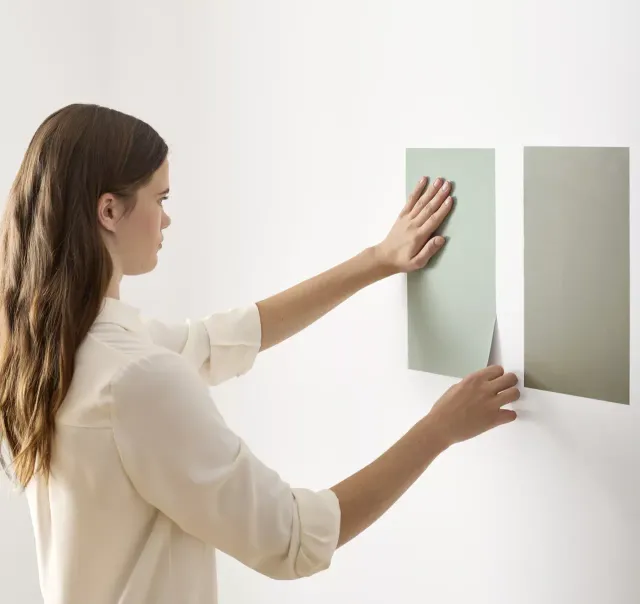
Use the visualizer to narrow your shortlist, then confirm the finalist on your actual wall. A peel-and-stick sample of Pale Oak, checked in morning and evening light, is the last step before a gallon.
- Made with real paint
- Delivered next day
- Peels off clean
 4.8 · 1,842 reviews