Classic Gray
OC-23 · Benjamin Moore


Benjamin Moore
Classic Gray
OC-23
Subtle yellow-beige, a warm color
- Color family
- White
- Sold for
- Interior and exterior
Benjamin Moore Classic Gray OC-23 is an off-white with a quiet gray-beige cast, closer to a warm white than to any gray in the fan deck. Its LRV of 74 puts it in off-white territory, light enough to brighten a dim room while keeping enough pigment to read as a color beside bright white trim. Bathrooms, bedrooms and open living rooms are where it is used most, often through a whole house.
Is Classic Gray warm or cool? Undertones by the numbers
leans yellow
Undertone
Subtle yellow-beige
A gentle lean, quiet on the wall.
Classic Gray holds less pigment than almost any color people call a greige: a small amount of yellow, no red and only a trace of green. That is why the name misleads. On a chip beside a true white it looks gray; on a wall beside cream cabinets it looks like a soft white. Warm oak and brass tip it warm, cool marble and chrome tip it gray, and in both cases the shift is small because there is so little color to move. Next to Carrara or a white quartz with gray veining it settles into the veining rather than fighting it.
Classic Gray in north, south, east and west light
In a north-facing room Classic Gray behaves better than most off-whites: the warmth thins but the walls stay light rather than turning cold, which is why it is a common answer for basements and rooms with one small window. South light warms it and can take it to plain cream by late afternoon. East rooms show the softest version in the morning and the grayest at dusk. West sun in the last hour will find whatever gold is in it, most visibly on the wall the light lands on. Keep the bulbs at 2700K to 3000K to hold it steady.
Watch for
- Reads as a white, not a gray, in any room with plenty of daylight
- Can go cream on a south wall in late afternoon sun
- Sits so close to some trim whites that the two lines blur
Best rooms and surfaces for Classic Gray
This is a whole-house color, and it is used that way: hallways, stairwells, open living rooms and bedrooms in the same can, with the trim in a brighter white for definition. Bathrooms are its other stronghold, since it stays light under downlights and takes marble, warm brass or matte black without a fight. It also works on kitchen cabinets when you want a softer white than a true white, though the doors will read almost trim-colored against pale counters. Where it disappoints is a room already flooded with light, where it stops reading as a color at all and the walls simply look white.
Classic Gray on an exterior
Benjamin Moore sells Classic Gray for exterior use, though it is a light choice for siding. Full sun takes it straight to white, so the gray in the name will not survive on a south elevation; shaded walls and porch ceilings keep more of it. It is more often used outside as a body color on a house with dark trim, or on trim itself against a mid-tone siding, where its softness keeps the edges from looking harsh.
Try Classic Gray on your own walls
Upload a photo of your room, or the outside of your house, and TryMyHome renders Classic Gray onto the walls so you can judge it in your light, with your floors and furniture. Your first five renders are free.


Trusted by 19,897+ happy homeowners
Classic Gray vs Pale Oak, Balboa Mist, Agreeable Gray, Edgecomb Gray and Silver Satin
 Pale OakClassic Gray
Classic Gray vs Pale Oak OC-20
Classic Gray is noticeably lighter; both have a subtle yellow-beige undertone.
Pale Oak OC-20 reflects five points less and carries a little more beige, so it holds a tone where Classic Gray tends toward white. In a bright room that gap decides it: Pale Oak still looks like a wall color while Classic Gray reads as an extension of the trim. In a dark hallway the advantage flips and Classic Gray keeps the space open. Both are used whole-house, so the choice is usually how visible you want the walls to be.
 Balboa MistClassic Gray
Classic Gray vs Balboa Mist OC-27
Classic Gray is noticeably lighter; both have a subtle yellow-beige undertone.
Balboa Mist OC-27 is eight points darker and noticeably grayer on a wall, enough that the two are rarely mistaken once they are up. Classic Gray keeps a room bright and quiet; Balboa Mist gives it a soft, definite color. The pair is worth testing together in a bedroom, because the same trim white will look crisp beside Balboa Mist and nearly invisible beside Classic Gray.
 Agreeable GrayClassic Gray
Classic Gray vs Agreeable Gray SW 7029
Classic Gray is much lighter; both have a subtle yellow-beige undertone.
Agreeable Gray SW 7029 is fourteen points darker and holds far more beige, so calling them alternatives stretches the point: one is a greige and the other is an off-white. People compare them anyway because both are sold as the safe whole-house neutral. If your rooms have plenty of light and you want the walls to read gray, Agreeable Gray delivers it. If the rooms are dark and you want them to feel open, Classic Gray does that job better.
 Edgecomb GrayClassic Gray
Classic Gray vs Edgecomb Gray HC-173
Classic Gray is much lighter; undertone subtle yellow-beige vs noticeable yellow-beige.
Edgecomb Gray HC-173 is eleven points darker and much warmer, a beige-forward greige against this color's near-white. The two get compared because both are named after gray and neither is very gray. Choose Edgecomb Gray for a room with wood floors and cream cabinetry that should feel warm on its own; choose Classic Gray when the same room already has warmth in it and the walls should just stay light.
 Silver SatinClassic Gray
Classic Gray vs Silver Satin OC-26
Classic Gray is a touch darker; undertone subtle yellow-beige vs subtle yellow-leaning green.
Silver Satin OC-26 is the color Benjamin Moore itself lists as this one's closest relative, and it is only a point lighter, so on a wall the two are hard to separate. The difference is the lean: Silver Satin runs slightly green where Classic Gray runs slightly yellow, which shows up beside a warm wood floor. Rooms with oak and brass usually suit Classic Gray, while rooms with cool stone or gray-washed wood suit Silver Satin.
Questions about Classic Gray
Is Classic Gray OC-23 the same color as 1548?
Yes, it is one color sold under two codes. OC-23 is the Off White collection number and 1548 is the number the same paint carries in the numbered deck, so a can mixed to either is identical. The two codes turn up in different fan decks and different store systems, which is why the question comes up so often. Nothing about the formula changes between them.
Does Classic Gray look purple?
It has no red in its measurement, so any violet reading is borrowed from the room. The usual sources are a blue-gray floor, cool LED downlights or a lavender-toned carpet next to the wall. Add warmth at floor level, or drop the bulbs to 2700K, and the same wall goes back to a soft warm white.
Is Classic Gray good for a bathroom?
It is one of the most used bathroom colors in the Benjamin Moore range, and the reason is its lightness: it holds up under downlights where a darker greige would go muddy. It sits well with Carrara, honed marble and gray-veined quartz because it is quiet enough not to compete with the stone. Warm the room with brass or wood if the tile is cold.
What colors go with Classic Gray?
The brand's own scheme pairs it with Simply White OC-117, then Stone Harbor 2111-50 and Stone Brown 2112-30 for depth. In practice it takes almost any warm wood, white marble and both black and brass hardware. Strong beiges beside it are the one risk, since they will make the walls look gray and slightly dirty by comparison.
Is there a Sherwin-Williams version of Classic Gray?
By measurement several Sherwin-Williams colors land almost on top of it: Moderne White SW 6168 and Heron Plume SW 6070 are the nearest, both close enough to be hard to tell apart, with Mortar SW 9584 just behind. Origami White SW 7636, which has a page here, is also very close. None of these is an official match, since neither brand publishes conversions to the other.
Get a sample before you paint
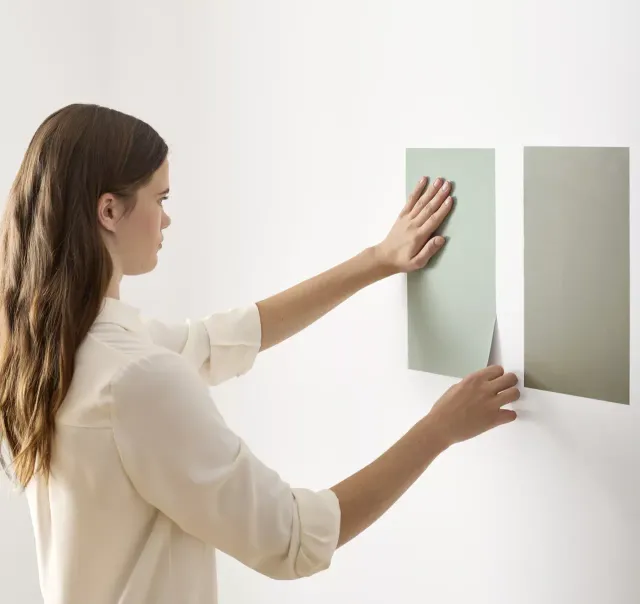
Use the visualizer to narrow your shortlist, then confirm the finalist on your actual wall. A peel-and-stick sample of Classic Gray, checked in morning and evening light, is the last step before a gallon.
- Made with real paint
- Delivered next day
- Peels off clean
 4.8 · 1,842 reviews