White Dove
OC-17 · Benjamin Moore
White Dove OC-17 as a flat swatch, not a painted room
Benjamin Moore
White Dove
OC-17
Subtle yellow-leaning green, a green color
- Color family
- White
- Sold for
- Interior and exterior
Benjamin Moore White Dove OC-17 is a soft white with a little warmth and no yellow glare, the white most often chosen for walls, trim and cabinets alike. Its LRV of 83 puts it in the off-white band, bright enough to lift a room without the hard glare of a pure white. Our method reads it as a subtle yellow-leaning green: a touch of yellow kept in check by a trace of green, which is why it reads soft rather than creamy.
Updated
Is White Dove warm or cool? Undertones by the numbers
leans yellow-green
Undertone
Subtle yellow-leaning green
A gentle lean, quiet on the wall.
Measured, White Dove has a small amount of yellow, a trace of green and almost no red. The yellow is what keeps it from reading stark; the green is what stops it turning creamy, and it is the reason the color can look faintly gray next to a warmer white. Beside a cream like Alabaster SW 7008 it looks cleaner and a shade cooler; beside a crisp white like Extra White SW 7006 it looks warm and soft. On its own, in daylight, it reads as a plain, quiet white with none of the yellow that people complain about in older off-whites.
White Dove in north, south, east and west light
White Dove holds up in every exposure because there is so little pigment in it to shift. In a north-facing room, where cool light brings out the green, it goes a little grayer and cooler, still white but no longer warm; a warm wood floor or warm bulbs bring the softness back. South and west light warm it toward cream through the afternoon, which is when it looks most like the chip. East rooms get the brightest, cleanest version in the morning.
Watch for
- Turns a little gray in a north room, most of all on a wall facing away from the window
- Reads creamier than expected on a sunny south wall in the late afternoon
- Looks slightly yellow beside a blue-white LED, so match the bulbs to the room
Best rooms and surfaces for White Dove
White Dove is a whole-house white: walls in every room, and the same color on trim and ceilings in a different sheen if you want one white through the house. It is one of the most used cabinet whites because it is soft enough to hide fingerprints and warm enough to sit with wood floors, marble and brass, while still reading white against a colored wall. In a bathroom it is at its coolest, so pair it with warm metal and wood rather than gray tile. On a ceiling above a colored wall it reads clean white; above a warmer cream it can look a shade gray.
White Dove on an exterior
Benjamin Moore sells White Dove for exterior use, and it is a common choice for siding and trim on a whole house. In full sun it reads brighter and cooler than on the chip, close to a plain white, so it suits a house you want white without glare rather than a cream. As trim it holds its own against dark siding such as Iron Ore SW 7069 or a navy, and on a front door it reads soft rather than stark.
Try White Dove on your own walls
Upload a photo of your room, or the outside of your house, and TryMyHome renders White Dove onto the walls so you can judge it in your light, with your floors and furniture. Your first five renders are free.


Trusted by 19,897+ happy homeowners
White Dove vs Alabaster, Greek Villa, Pure White and Shoji White
White Dove vs Alabaster SW 7008
White Dove is a touch lighter; undertone subtle yellow-leaning green vs subtle yellow-beige.
Alabaster SW 7008 is the Sherwin-Williams white people compare White Dove against most, and the two are close: Alabaster measures a subtle yellow-beige and a touch darker, so it reads a little creamier and warmer on the wall. Choose Alabaster for a cozy, cream-leaning white with warm wood; choose White Dove when you want the white to stay white and let the room supply the warmth.
White Dove vs Greek Villa SW 7551
White Dove is a touch darker; undertone subtle yellow-leaning green vs subtle yellow-beige.
Greek Villa SW 7551 is a touch lighter than White Dove and measures a subtle yellow-beige, so it leans cream where White Dove leans clean. In a bright room Greek Villa can read slightly yellow by comparison; in a dim room it holds its warmth better. Pick Greek Villa for a warmer, softer white; pick White Dove for a cleaner one that still avoids glare.
White Dove vs Pure White SW 7005
White Dove is a touch darker; undertone subtle yellow-leaning green vs faint yellow-beige.
Pure White SW 7005 is a touch lighter and measures a faint yellow-beige, closer to a true white than White Dove. Side by side, Pure White is the crisper of the two and White Dove the softer. They pair well as trim and wall: Pure White on the trim sharpens White Dove walls without the hard edge a blue-white would give.
White Dove vs Shoji White SW 7042
White Dove is noticeably lighter; undertone subtle yellow-leaning green vs subtle yellow-beige.
Shoji White SW 7042 is noticeably darker than White Dove and a subtle yellow-beige, an off-white with visible warmth rather than a white. Where White Dove disappears into a bright room, Shoji White reads as a color against white trim. Choose Shoji White for a warm, muted wall; choose White Dove when the wall should read white.
Questions about White Dove
Does White Dove look yellow or gray?
Both, depending on the neighbor. Its measurement holds a little yellow and a trace of green, so next to a blue-white it looks faintly yellow and next to a cream it looks faintly gray. On its own in daylight it reads as a plain soft white, and the shift is small in either direction.
Is there a Sherwin-Williams version of White Dove?
Not by name. By measurement the closest Sherwin-Williams colors are Cold Foam SW 9504 and Cotton SW 9581, near enough to be hard to tell apart, and Alabaster SW 7008 is the closest with its own page here. Searches for a Sherwin-Williams White Dove usually land on Dover White SW 6385, which is a different, creamier color.
What white trim looks right with White Dove walls?
The same color in a higher sheen is the most common answer, and it keeps the house to one white. For visible contrast a crisper white on the trim, such as Pure White SW 7005 or Extra White SW 7006, makes the walls read warmer and softer. Benjamin Moore's Simply White OC-117 is the other usual pairing.
What colors go with White Dove?
Almost anything, which is why it is used so widely. Warm wood floors, brass and marble bring out its softness. For a colored wall against White Dove trim, muted greens such as Evergreen Fog SW 9130, dark neutrals such as Iron Ore SW 7069 and navies all hold up; strong yellow-beiges beside it can make the white look gray.
Is White Dove a good cabinet color?
Yes, and it is one of the most used. It is soft enough not to show every mark, warm enough to sit with wood and stone, and still reads white against a colored wall. In a kitchen with cool gray tile it can look a shade gray, so bring warmth in with the counter, the floor or the hardware.
Is White Dove good for exteriors?
Yes. It is sold for exterior use and is common on both siding and trim. Full sun pushes it toward a plain bright white, so it suits a house you want white without glare rather than a cream; on trim against dark siding it reads clean and soft at once.
Get a sample before you paint
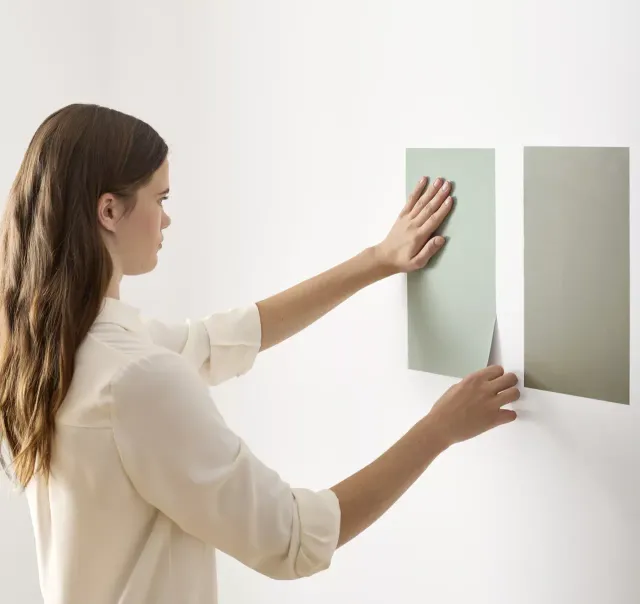
Use the visualizer to narrow your shortlist, then confirm the finalist on your actual wall. A peel-and-stick sample of White Dove, checked in morning and evening light, is the last step before a gallon.
- Made with real paint
- Delivered next day
- Peels off clean
 4.8 · 1,842 reviews