Collingwood
OC-28 · Benjamin Moore


Benjamin Moore
Collingwood
OC-28
Subtle yellow-beige, a warm color
- Color family
- White
- Sold for
- Interior and exterior
Benjamin Moore Collingwood OC-28 is a light greige that sits at the darker end of the Off White collection, gray in feel with a warm base under it. Its LRV of 62 keeps it in the light band while giving the walls more body than the off-whites beside it. It is chosen for whole houses, open living rooms and hallways, usually by people who want a neutral that still reads as a color in daylight.
Is Collingwood warm or cool? Undertones by the numbers
leans yellow
Undertone
Subtle yellow-beige
A gentle lean, quiet on the wall.
Collingwood is a plain warm gray by the numbers, with a small amount of yellow and a red-green reading of exactly zero, which is unusual and worth knowing. It means the color has no lean of its own in either direction, so whatever the room supplies is what shows. Warm oak and cream trim bring the beige forward and the walls look like a soft greige. Cool tile, gray carpet or a north window leave the yellow unsupported and the walls drift toward a flat, slightly violet gray. That absence of a lean, rather than any pigment, is behind most of what people report about this color.
Collingwood in north, south, east and west light
North light is the exposure that changes this color most, because there is nothing in the paint to resist it: the yellow thins out and the walls go cool and gray, sometimes with a violet edge. A wood floor, warm bulbs and a cream trim are what hold it together in that room. South light restores the warmth and can make it look like a soft greige by midday. East rooms read gray in the afternoon after a warm morning, and a west wall picks up a gold cast for the last hour of sun. Bulbs at 2700K to 3000K keep it honest.
Watch for
- Goes cool and slightly violet in a north room with gray flooring
- Needs warm bulbs more than most greiges, since it has no lean to fall back on
- Reads noticeably darker than the chip on the wall furthest from the window
Best rooms and surfaces for Collingwood
This is a whole-house neutral with enough depth for large rooms, which is where it does better than the lighter colors around it: in an open plan with high ceilings it still reads as a wall color rather than disappearing into the trim. Hallways and stairwells take it well as long as there is some daylight. In a bedroom it is quiet and easy to furnish around. The rooms to think twice about are small north-facing ones and windowless bathrooms, where it can settle into a cold gray, and any room whose flooring is a cool gray with no warm material to balance it.
Collingwood on an exterior
Benjamin Moore sells Collingwood for exterior use, and it is a workable light gray for siding. Sunlight lifts it toward an off-white and shade holds the gray, so the elevations will not match, which suits a house with several planes and some depth to it. White trim keeps it crisp, and a dark door or dark shutters give it the contrast it needs, since on its own across a whole facade it can look washed. It sits comfortably beside gray stone and cool brick.
Try Collingwood on your own walls
Upload a photo of your room, or the outside of your house, and TryMyHome renders Collingwood onto the walls so you can judge it in your light, with your floors and furniture. Your first five renders are free.


Trusted by 19,897+ happy homeowners
Collingwood vs Agreeable Gray, Gossamer Veil, Balboa Mist, Pale Oak and Revere Pewter
 Agreeable GrayCollingwood
Collingwood vs Agreeable Gray SW 7029
Collingwood is a touch lighter; both have a subtle yellow-beige undertone.
Agreeable Gray SW 7029 measures so close to this color that the two are hard to separate on a wall, about a point apart in reflectance with almost identical warmth. Practically, they are alternatives rather than choices, and the deciding factor is usually which brand's store is nearer. If anything, Agreeable Gray is fractionally warmer and Collingwood fractionally cleaner, a difference you would only catch with both samples on the same wall at once.
 Gossamer VeilCollingwood
Collingwood vs Gossamer Veil SW 9165
Collingwood is a touch darker; both have a subtle yellow-beige undertone.
Gossamer Veil SW 9165 is the closest match to this color in any other brand, near enough that the measurement puts almost nothing between them. Anyone trying to repeat a Collingwood house in Sherwin-Williams paint should start here rather than with a better-known greige. Expect the same behavior too: both need a warm floor or warm bulbs in a north room, and both hold up well in an open plan.
 Balboa MistCollingwood
Collingwood vs Balboa Mist OC-27
Collingwood is noticeably darker; both have a subtle yellow-beige undertone.
Balboa Mist OC-27 is four points lighter and reads noticeably softer on a wall, with the same quiet warmth. The two answer different problems. Balboa Mist keeps a small or dim room open; Collingwood gives a bright or oversized room something to hold. In the same house they work as a pair, the lighter color upstairs and in bathrooms, the darker one through the main floor.
 Pale OakCollingwood
Collingwood vs Pale Oak OC-20
Collingwood is noticeably darker; both have a subtle yellow-beige undertone.
Pale Oak OC-20 is six points lighter and warmer in its measurement, which puts it closer to an off-white while this one stays a light gray. A room in Pale Oak looks bright and neutral; the same room in Collingwood looks gray and finished. Pale Oak is the safer choice against cream cabinetry, and Collingwood is the better one against white cabinetry, where the extra depth stops everything blending together.
 Revere PewterCollingwood
Collingwood vs Revere Pewter HC-172
Collingwood is noticeably lighter; both have a subtle yellow-beige undertone.
Revere Pewter HC-172 is six points darker and carries much more color, the difference between a light greige and a mid-tone one. In a room with good light Revere Pewter reads rich and Collingwood reads clean. In a dark room Revere Pewter can close things down while this color stays livable. People often test them together and then choose by ceiling height, since the darker color wants more wall to work with.
Questions about Collingwood
Does Collingwood look purple?
It can, and its measurement explains why better than most colors do. There is no red in it and no green either, so nothing anchors the color when the light is cool. In a north room with gray flooring the eye fills that gap and reads violet. Add warmth at floor level or drop the bulbs to 2700K and the same wall goes back to a soft greige.
Is Collingwood a good whole-house color?
Yes, and it is one of the more common choices for it, because it has enough depth to survive a bright open plan without going pale. Run it through the main rooms and hallways, keep the trim in a bright white for definition, and give the north-facing rooms a warm floor or a rug. Small windowless spaces are the ones to paint a lighter color instead.
What colors go with Collingwood?
Benjamin Moore's own scheme sets it with White Heron OC-57 and Steam AF-15 as the light notes, then Amazon Soil 2115-30 and Silhouette AF-655 for depth. In a room it takes warm wood, gray stone, black metal and muted blues. Keep strong yellow-beiges off the same plane, since they turn it grayer and colder than it really is.
What is one shade lighter than Collingwood?
Balboa Mist OC-27 is the usual step up at four points lighter with the same warmth, and Picket Fence CSP-370 is a smaller step, a point and a half brighter. Going down, Nimbus 1465 is two points darker and slightly grayer. The color is not on a fan-deck strip, so these steps come from its nearest measured relatives.
Get a sample before you paint
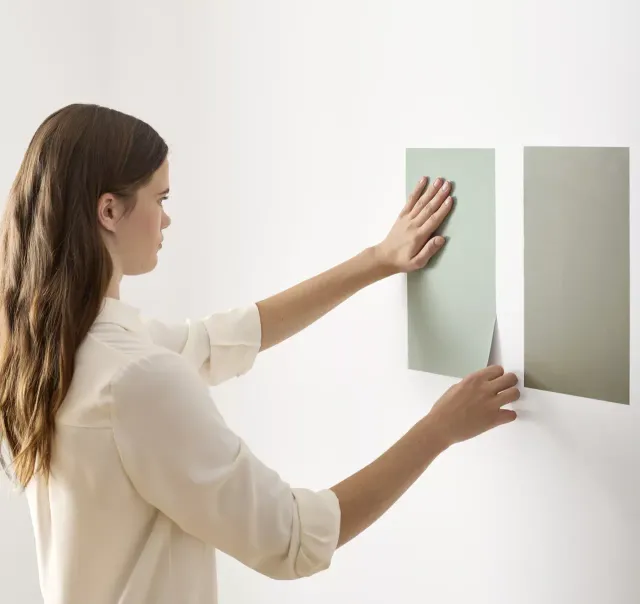
Use the visualizer to narrow your shortlist, then confirm the finalist on your actual wall. A peel-and-stick sample of Collingwood, checked in morning and evening light, is the last step before a gallon.
- Made with real paint
- Delivered next day
- Peels off clean
 4.8 · 1,842 reviews