Wrought Iron
2124-10 · Benjamin Moore


Benjamin Moore
Wrought Iron
2124-10
None (a true neutral), a true neutral
- Color family
- Neutral
- Sold for
- Interior and exterior
Benjamin Moore Wrought Iron 2124-10 is a near-black with no color in it, the last and darkest step on its own gray strip. Its LRV of 8 means the wall gives back almost nothing, so the paint reads as a solid shape rather than as a shade. Our method finds no lean at all, a true neutral. It is used on interior doors, window sash, cabinets and trim more often than on four walls.
Is Wrought Iron warm or cool? Undertones by the numbers
too close to gray to lean
Undertone
None (a true neutral)
A true neutral, no lean at all.
Measured, Wrought Iron holds no red, green or blue worth naming. It is one of the few paints that is genuinely neutral rather than a black with a story attached, and that makes it the color that borrows from whatever is around it. Beside oak flooring it looks faintly warm, beside gray-veined marble faintly cool, and on its own it looks like a soft black. Its nearest relatives do have leans, which is how you spot the difference: Cheating Heart 1617 is a shade lighter and tips slightly blue, Midnight Oil 1631 sits a hair deeper, Graphite 1603 deeper again.
Wrought Iron in north, south, east and west light
A color with nothing in it has little to shift, so this is one of the easier darks to place. A north room takes it a little cooler and deeper than the chip and stops there, which makes it a safer choice for that exposure than any navy or brown-black. South light lifts it a fraction and it stays neutral. Across an east or west room it barely moves through the day, a touch cool in the morning and a touch warm at sunset. The bulb decides the rest: 2700K warms it, 4000K cools it, 3000K leaves it alone.
Watch for
- Shows dust, fingerprints and roller lap marks more than anything else in the room
- Borrows warmth from whatever sits next to it, so sample it against the actual floor
- Under 4000K downlights it can turn into a cold gray-black instead of a soft one
Best rooms and surfaces for Wrought Iron
Wrought Iron is at its best on the things in a room rather than on the room itself: interior doors, window sash, a stair rail, a fireplace surround, or base cabinets under a light counter. On all four walls it is a decision, and it suits a den, a media room or a powder room where the point is to feel enclosed. In a bedroom it usually lands better on the trim or a single wall than everywhere. A vanity in satin wipes clean easily. Because there is no undertone to clash with anything, it can be dropped into a room whose tile, stone and floor were chosen years ago.
Wrought Iron on an exterior
Benjamin Moore sells Wrought Iron for exterior use, where it is mostly a trim, sash, shutter and front door color rather than a body color. Full sun shows it as a soft black instead of a true one, and a shaded elevation closes it up to black. A door painted in it stays even through the day because the sun has no undertone to pull out. It is the usual pick when a house needs black window frames without the glare of a jet black.
Try Wrought Iron on your own walls
Upload a photo of your room, or the outside of your house, and TryMyHome renders Wrought Iron onto the walls so you can judge it in your light, with your floors and furniture. Your first five renders are free.


Trusted by 19,897+ happy homeowners
Wrought Iron vs Iron Ore, Iron Mountain, Kendall Charcoal and Cyberspace
 Iron OreWrought Iron
Wrought Iron vs Iron Ore SW 7069
Wrought Iron is a touch lighter; both have a none (a true neutral) undertone.
Iron Ore SW 7069 is the comparison people actually run, and the honest answer is that both measure as true neutrals with no lean to separate them. What differs is depth: Iron Ore sits about three points darker at an LRV of 6, so it lands as a firmer black on cabinets and on siding. Wrought Iron keeps a little more light in it and lets panel profiles and door edges still show. Take Iron Ore for the heavier black, Wrought Iron where the shape of the door should stay visible.
 Iron MountainWrought Iron
Wrought Iron vs Iron Mountain 2134-30
Wrought Iron is a touch darker; undertone none (a true neutral) vs faint orange.
Iron Mountain 2134-30 is the lighter and warmer of Benjamin Moore's own darks. It measures a faint orange at an LRV of 11, roughly three points up, and that small amount of warmth becomes obvious once the two sit side by side: Iron Mountain reads as a very dark warm gray, Wrought Iron as black. Iron Mountain is the answer when the wall should still be understood as gray.
 Kendall CharcoalWrought Iron
Wrought Iron vs Kendall Charcoal HC-166
Wrought Iron is noticeably darker; undertone none (a true neutral) vs faint yellow-brown.
Kendall Charcoal HC-166 is a real dark gray rather than a near-black, about seven points lighter at an LRV of 15 with a faint yellow-brown running through it. That gap changes what a room does with corners: Kendall Charcoal keeps its shadows and its depth, Wrought Iron flattens them into one plane. Cabinet fronts are where the two get cross-shopped, and the deciding factor is whether the kitchen has the daylight to carry the darker one.
 CyberspaceWrought Iron
Wrought Iron vs Cyberspace SW 7076
Wrought Iron is a touch lighter; undertone none (a true neutral) vs faint blue.
Cyberspace SW 7076 is the near-black with a blue in it, faint but plain enough against a white ceiling. Wrought Iron has nothing there to find. Depth is not the question, since Cyberspace measures an LRV of 6 and the two are within a few points. If the room's other finishes are cool, Cyberspace joins in with them. If they are mixed, Wrought Iron stays out of the argument.
Questions about Wrought Iron
Is Wrought Iron actually black?
It is not a black, but it behaves like one. The measurement puts it at a true neutral reflecting about eight percent of the light in the room, which is dark enough that most people call it black on sight. Set against a real black such as Tricorn Black SW 6258 it is visibly softer, and that softness is why it ends up on doors and cabinets.
What colors go with Wrought Iron?
Benjamin Moore's picks beside it are White Ice OC-58, Satin Shoes 2159-70, Wedgewood Gray HC-146 and Jack O'Lantern 2156-30: a cool white, a cream, a soft blue and an orange. A neutral this flat will take any of them. Most rooms in practice stop at one white and one wood tone, and the hardware is free, since brass, nickel and matte black all sit on it.
Is Wrought Iron a good color for interior doors?
Yes, and doors are one of its more common uses. Near-black doors against white walls give a room its structure without introducing a color, which is exactly what a paint with no undertone is for. Use a satin or semi-gloss enamel so the face wipes clean, and accept that brush and roller marks show more here than on a pale door.
What is one shade lighter than Wrought Iron?
Trout Gray 2124-20 is the step up on its own strip, roughly eight points lighter and a clear dark gray rather than a near-black. Cheating Heart 1617 is the far smaller step, close enough that the change is barely worth the paint. The strip stops at Wrought Iron, so anything deeper comes from outside it, and Midnight Oil 1631 or Graphite 1603 go there.
Is there a Sherwin-Williams equivalent to Wrought Iron?
Nothing carries the name, and the two nearest colors in other brands are at Farrow & Ball: Off-Black No. 57 and Liquorice No. CB10 are both hard to tell apart from it. At Sherwin-Williams the closest are Cyberspace SW 7076 and Iron Ore SW 7069, near relatives rather than matches. For an exact copy, a Sherwin-Williams store can match the Benjamin Moore formula.
Get a sample before you paint
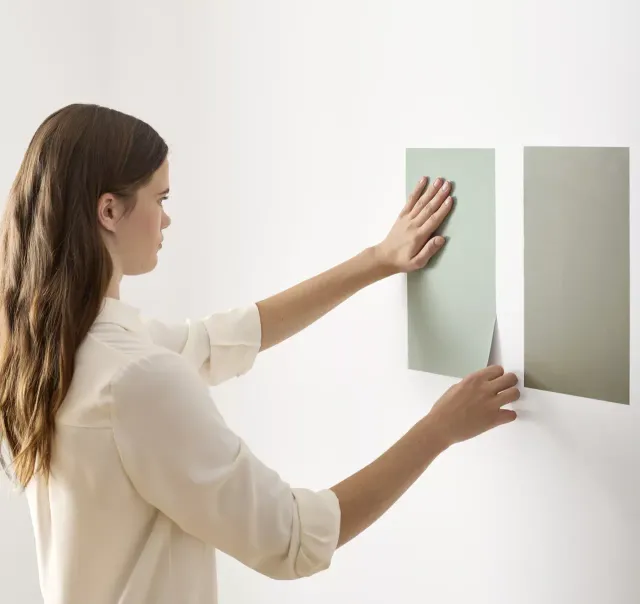
Use the visualizer to narrow your shortlist, then confirm the finalist on your actual wall. A peel-and-stick sample of Wrought Iron, checked in morning and evening light, is the last step before a gallon.
- Made with real paint
- Delivered next day
- Peels off clean
 4.8 · 1,842 reviews