White Duck
SW 7010 · Sherwin-Williams


Sherwin-Williams
White Duck
SW 7010
Subtle yellow-beige, a warm color
- Color family
- White
- Sold for
- Interior and exterior
Sherwin-Williams White Duck SW 7010 is a warm off-white with an LRV of 74, a white that gives a room most of its light back and keeps just enough for the walls to read as walls. By measurement its undertone is a subtle yellow-beige, sitting almost dead on yellow with no pull toward pink or green. On a wall it is the same color as Shoji White SW 7042 to almost everyone, and it is used the same way: living rooms, bedrooms, cabinets and siding.
Updated
Is White Duck warm or cool? Undertones by the numbers
leans yellow
Undertone
Subtle yellow-beige
A gentle lean, quiet on the wall.
White Duck measures warm with a modest yellow lean and almost nothing toward red or green, a plain yellow-beige. That plainness is the point: there is no second color hiding in it, so it does not drift pink or khaki, it only reads more beige in warm light and more gray in cool light. Against white trim it shows as a pale greige; beside warm oak and tan fabric it reads beige; beside gray tile it reads as a soft white again. Sherwin-Williams pairs it with tans, which tells you which side it lives on. Oyster White SW 7637, Nacre SW 6154 and Shoji White SW 7042 are all hard to tell apart from it; Natural Choice SW 7011 is a touch darker with a hint more green.
White Duck in north, south, east and west light
North light takes White Duck a step toward gray, a soft greige-white that stays comfortable, and because it has no green or pink in it the gray stays clean rather than drifting; a north-facing room is a fair test of it. That makes it one of the safer warm whites for a north bedroom. South light brings out the beige and a sunlit wall can look close to a light tan in the afternoon. East rooms see it warmest early; a west window warms it toward gold as the sun drops. It wants 2700K to 3000K bulbs; 4000K bulbs turn it flat and gray.
Watch for
- In a sunny south room with tan furniture the walls can read as a light beige, not a white
- Beside Extra White SW 7006 trim it shows as a color; beside Alabaster SW 7008 the two nearly merge
- Under 4000K bulbs in a bathroom it loses its warmth and looks flat gray
Best rooms and surfaces for White Duck
The rooms people ask about most for White Duck are the ones it suits best, and it runs through a whole house without a break. In a living room it reads as a warm, slightly shadowed white that lets furniture carry the color; in a bedroom it is calm and warm enough for a north exposure. On kitchen cabinets it reads as a soft greige-white, clean beside white quartz and warm beside wood, with a lighter wall behind it so the room does not go monotone. In a bathroom it works with warm bulbs and wood or cream finishes, and goes gray beside white tile under cool light. It is too deep for trim against a light wall, and it looks dull beside cool blue-grays.
White Duck on an exterior
White Duck also appears in the Top Exterior Colors collection, the shortlist Sherwin-Williams keeps for siding. On siding it reads as a warm white with a faint tan in full sun and a soft greige in shade, so a house looks lighter from the sunny side than from the street on a cloudy day. It suits brick, stone, cedar and brown or black roofs, with Extra White SW 7006 or Pure White SW 7005 trim for crisp edges. A door in Urbane Bronze SW 7048 or Tricorn Black SW 6258 sits well against it.
Try White Duck on your own walls
Upload a photo of your room, or the outside of your house, and TryMyHome renders White Duck onto the walls so you can judge it in your light, with your floors and furniture. Your first five renders are free.


Trusted by 19,897+ happy homeowners
White Duck vs Shoji White, Alabaster, Oyster White and Natural Choice
 Shoji WhiteWhite Duck
White Duck vs Shoji White SW 7042
White Duck is a touch darker; both have a subtle yellow-beige undertone.
Shoji White SW 7042 and White Duck are near twins: three tenths of a point apart in lightness and both a plain yellow-beige, so the measured difference is smaller than the difference between two coats. Shoji White reads a hair cleaner, White Duck a hair more beige, and most people cannot tell them apart on a wall. Pick whichever you have already sampled; if you are starting fresh, let the rest of the palette decide, Shoji White for gray and black, White Duck for tan and wood.
 AlabasterWhite Duck
White Duck vs Alabaster SW 7008
White Duck is noticeably darker; both have a subtle yellow-beige undertone.
Alabaster SW 7008 is eight points lighter and creamier; beside it White Duck reads as a pale greige rather than a white. The pair is a natural wall and trim combination, White Duck on the walls and Alabaster on the trim and ceiling, as long as the room gets enough light to keep them apart. Choose Alabaster alone for a bright, creamy room; choose White Duck for walls with visible depth.
 Oyster WhiteWhite Duck
White Duck vs Oyster White SW 7637
White Duck is a touch lighter; both have a subtle yellow-beige undertone.
Oyster White SW 7637 is two steps down the same strip, a point and a half darker, with a lean that tips slightly toward green where White Duck's stays on yellow. Side by side Oyster White looks a little stonier and White Duck a little warmer. Oyster White suits an exterior or a room with cool finishes; White Duck suits a beige palette indoors.
 Natural ChoiceWhite Duck
White Duck vs Natural Choice SW 7011
White Duck is a touch lighter; both have a subtle yellow-beige undertone.
Natural Choice SW 7011 is the next color down the strip, about a point darker, and carries a hint more green in its beige. In a north room Natural Choice can read faintly khaki where White Duck stays a clean greige. Choose Natural Choice for a room with sage, olive or gray in it; choose White Duck when you want the warm white with no second color in it.
Questions about White Duck
Does White Duck look yellow or green?
Neither on its own. Its lean is a plain yellow-beige with almost nothing toward green or red, so it reads more beige in warm light and grayer in cool light, and stops there. Beside a bright white it can look faintly yellow by contrast, and beside cool gray tile it can look a touch green; the pigment itself does neither.
What colors go with White Duck?
Sherwin-Williams' two accents for it, Portico SW 7548, a mid tan, and Resort Tan SW 7550, a deep tan, place it firmly in a beige palette. In practice it sits well with oak, walnut, brass, black and warm stone, and with deeper greiges such as Agreeable Gray SW 7029 or Accessible Beige SW 7036 on an accent wall.
Is White Duck good for a bedroom?
Yes. In a bedroom it reads as a calm warm white, and in a north-facing bedroom it stays soft rather than going cold. Use 2700K bulbs in the lamps so the walls hold their warmth at night, and pair it with white or cream bedding and a wood or rattan headboard rather than cool grays, which make it look dull.
Is White Duck good for kitchen cabinets?
Yes, as a soft greige-white cabinet. It reads clean beside white quartz and warm beside butcher block, and it takes brass, bronze and black hardware equally well. Put a lighter white on the walls, such as Alabaster SW 7008 or Greek Villa SW 7551, and warm under-cabinet lighting so the doors do not go gray.
What is one shade lighter than White Duck?
Shoji White SW 7042 is the step above it on strip 254, so close that the step is invisible on a wall; the first visible step up is Pearly White SW 7009. One shade darker is Natural Choice SW 7011, then Oyster White SW 7637. Among its closest matches, Nacre SW 6154 is a touch lighter and Pacer White SW 6098 a touch darker.
Get a sample before you paint
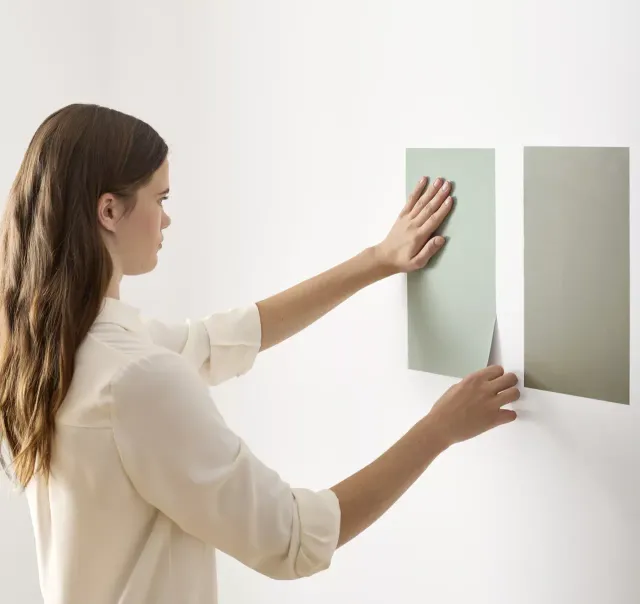
Use the visualizer to narrow your shortlist, then confirm the finalist on your actual wall. A peel-and-stick sample of White Duck, checked in morning and evening light, is the last step before a gallon.
- Made with real paint
- Delivered next day
- Peels off clean
 4.8 · 1,842 reviews