Elmira White
HC-84 · Benjamin Moore


Benjamin Moore
Elmira White
HC-84
Noticeable yellow-beige, a warm color
- Color family
- Neutral
- Sold for
- Interior and exterior
Benjamin Moore Elmira White HC-84 is a soft sandy beige rather than a white, despite the name, and one of the quieter Historical Colors. An LRV of 65 puts it in the light band, bright enough to lift a room and still clearly a color beside white trim. It measures dead on the line between the red and green sides of neutral, which is unusual at this weight: there is no second undertone in it waiting to surface.
Is Elmira White warm or cool? Undertones by the numbers
leans yellow
Undertone
Noticeable yellow-beige
A visible lean you see in daylight.
Measured, Elmira White is a yellow-beige at a noticeable level with nothing at all on the red or green axis, and that is the rarest part of it. Most beiges in this range lean one way and show it in a north room; this one has nothing to lean on. In practice that gives a color that looks the same in the morning and the evening, warmer or cooler with the light but never a different color. Against white trim it reads as a light sand. Against cream millwork the two blur, so the trim has to be a clean white to keep the line visible.
Elmira White in north, south, east and west light
In a north-facing room Elmira White is one of the safer warm beiges, because there is no green or pink in it for cool light to find: it simply reads a step cooler and stays sandy. South rooms bring the yellow up and the walls come closer to cream. East light is warm and clean in the morning and plain by mid afternoon. West light adds a little gold at the end of the day. Bulbs between 2700K and 3000K hold it steady, and even at 4000K it loses warmth rather than changing color.
Watch for
- Blurs into cream or antique-white trim, so the trim needs to be a clean white
- Comes closer to cream than to sand on a sunny south wall
- Sits so near Edgecomb Gray HC-173 that the two samples need labeling on the wall
Best rooms and surfaces for Elmira White
Elmira White carries a whole house well: light enough for hallways and stairwells with borrowed light, warm enough for bedrooms, and steady enough that connected rooms with different exposures still look like one color. It works above wainscoting and behind wood furniture without competing with either. On kitchen cabinets it is too light to give a kitchen structure, so it belongs on the walls with a deeper island below. In a bathroom it wants a clean white ceiling rather than a cream one, or the whole room reads yellow. It is a poor choice over orange-toned oak, where floor and wall run together.
Elmira White on an exterior
Benjamin Moore sells Elmira White for exterior use, where it works as a light body color under a dark roof and avoids the glare a true white would give. Full sun takes it close to cream and the shaded elevations bring the sand back. It needs a trim white with some snap, because a soft white beside it will look dirty; Glacier White OC-37 from its own coordinating list is the safe pick. Webster Green HC-130 is the shutter color that suits it best.
Try Elmira White on your own walls
Upload a photo of your room, or the outside of your house, and TryMyHome renders Elmira White onto the walls so you can judge it in your light, with your floors and furniture. Your first five renders are free.


Trusted by 19,897+ happy homeowners
Elmira White vs Pale Oak, Swiss Coffee, Manchester Tan, White Dove and Edgecomb Gray
 Pale OakElmira White
Elmira White vs Pale Oak OC-20
Elmira White is noticeably darker; undertone noticeable yellow-beige vs subtle yellow-beige.
Pale Oak OC-20 is four points lighter and the cooler of the two, a subtle yellow-beige where Elmira White is a noticeable one. On a wall Pale Oak passes for a warm off-white and Elmira White reads as a light sand. The pair gets shortlisted for the same job: Pale Oak for a room that should still feel white, Elmira White where the walls are meant to have some sand in them.
 Swiss CoffeeElmira White
Elmira White vs Swiss Coffee OC-45
Elmira White is much darker; undertone noticeable yellow-beige vs subtle yellow-beige.
Swiss Coffee OC-45 is seventeen points lighter and belongs to a different category, a soft white against a beige. Anyone weighing these two is deciding whether the room should read white or read warm, not choosing between two neutrals. Swiss Coffee makes trim disappear unless the trim is brighter still. Elmira White gives the trim something to sit against without taking much light out of the room.
 Manchester TanElmira White
Elmira White vs Manchester Tan HC-81
Elmira White is a touch lighter; both have a noticeable yellow-beige undertone.
Manchester Tan HC-81 is two points darker and carries clearly more yellow, so at almost the same lightness one reads as a tan and the other as a sand. Manchester Tan also leans a touch toward green, which Elmira White does not. In a room with warm oak floors Manchester Tan blends into the woodwork and Elmira White holds a little apart from it.
 White DoveElmira White
Elmira White vs White Dove OC-17
Elmira White is much darker; undertone noticeable yellow-beige vs subtle yellow-leaning green.
White Dove OC-17 is eighteen points lighter and it is a white; Elmira White, name aside, is not. The two are often used together, White Dove on trim and ceilings with Elmira White on the walls, which gives a warm room and a clean line at every edge. Weighing them as wall colors is really a question of whether the room can afford to give up the warmth.
 Edgecomb GrayElmira White
Elmira White vs Edgecomb Gray HC-173
Elmira White is a touch lighter; both have a noticeable yellow-beige undertone.
Edgecomb Gray HC-173 is the closest color to Elmira White in Benjamin Moore's range: two points darker, the same noticeable yellow-beige, and near enough that two boards on one wall need labels. Edgecomb Gray is the better known name and carries the weight of that; the color itself is all but the same. If the house already has Edgecomb Gray in it, there is no reason to switch.
Questions about Elmira White
Does Elmira White look yellow or gray?
Yellow, mildly, and never gray. The measurement puts a noticeable amount of yellow in it and nothing at all on the green or pink axis, so the color has only one direction it can move. Cool light mutes the yellow and warm light brings it forward, but there is no second cast waiting in it, which is usually what people are asking about.
What colors go with Elmira White?
The coordinating list is Glacier White OC-37 and Vapor AF-35 for the whites, Webster Green HC-130 for depth and Hazy Lilac 2116-40 for the soft note. It also takes wicker, oak, brass and warm limestone without effort. The pairing to avoid is a cream trim, which sits near enough to swallow the line between wall and woodwork.
What is one shade darker than Elmira White?
Bleeker Beige HC-80 is the next rung down its own strip at an LRV of 52, thirteen points deeper and a proper beige. If that is too far, Cedar Key OC-16 at 61 is the small move. Going up, Sand Dollar OC-71 at 82 is the next rung and is close to a plain off-white.
What is the Sherwin-Williams equivalent of Elmira White?
Dumpling SW 9616 is the nearest by measurement and would be hard to tell from it on a wall, with Grecian Ivory SW 7541 next. Of the Sherwin-Williams colors that have a page here, Natural Tan SW 7567 is the closest and Neutral Ground SW 7568 sits about six points lighter. The ranking is by measured distance between published colors.
Get a sample before you paint
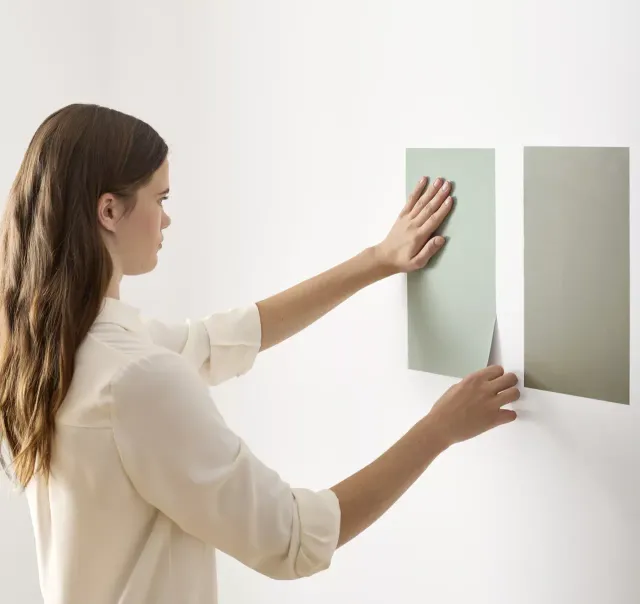
Use the visualizer to narrow your shortlist, then confirm the finalist on your actual wall. A peel-and-stick sample of Elmira White, checked in morning and evening light, is the last step before a gallon.
- Made with real paint
- Delivered next day
- Peels off clean
 4.8 · 1,842 reviews