Baby Fawn
OC-15 · Benjamin Moore


Benjamin Moore
Baby Fawn
OC-15
Noticeable yellow-beige, a warm color
- Color family
- White
- Sold for
- Interior and exterior
Benjamin Moore Baby Fawn OC-15 is a soft beige-greige from the Off White collection, warmer than most colors filed under white. Its LRV of 63 places it in the light band, so a room keeps its brightness while the walls hold a clear, gentle tan. Cabinets are what it is looked up for most often, followed by kitchen and living room walls in houses with oak or walnut floors.
Is Baby Fawn warm or cool? Undertones by the numbers
leans yellow
Undertone
Noticeable yellow-beige
A visible lean you see in daylight.
The warmth here is real and steady, not the kind that appears in one light and vanishes in another. Yellow does nearly all of the work, with a faint green behind it and no red at all, which is why the color reads as a clean beige rather than a pink or peach one. Its close neighbors show where it sits: Natural Cream OC-14 is a shade creamier, Elmira White HC-84 a shade grayer, and this one lands between them. On a cabinet door the beige is easy to see. On a wall in a bright room it can pass for a warm off-white.
Baby Fawn in north, south, east and west light
North-facing rooms cool it toward a warm gray and take away some of the beige, but not all of it, so the walls keep a little life where a paler greige would go flat; that is the main reason the color survives a north exposure. Direct south sun does the opposite and can make the walls read as light tan by early afternoon. In an east room it is warmest at breakfast and quiet by evening, and a west wall picks up gold in the last hour. Keep bulbs at 2700K to 3000K, since cooler light strips the warmth out of it quickly.
Watch for
- Looks distinctly tan next to a bright white trim, more than the chip suggests
- Loses most of its warmth under 4000K bulbs, which matters in a kitchen
- On a cabinet door in satin it reads a shade deeper than the same color on a wall
Best rooms and surfaces for Baby Fawn
Cabinets are its strongest use, and the searches follow that: on doors and drawer fronts it gives a warm painted finish that sits with oak, walnut, brass and honed stone, and it hides the marks a white kitchen shows within a week. On walls it carries a kitchen, a dining room or a living room in a house with wood floors, and it goes down a hallway without dimming it. It is less at home in a cool bathroom with white tile and chrome, where the beige has nothing to work with, and in a room with orange-toned floors it can double the warmth until everything reads yellow.
Baby Fawn on an exterior
Benjamin Moore puts this color on the exterior list as well as the interior one, and outdoors the sun lifts it so that the beige comes forward: a sunlit wall reads warmer and lighter than the sample, while a shaded wall holds more gray. It suits a house with stone, brick or a warm brown roof, and it takes a white trim cleanly. Against a blue-gray roof it can look yellow, so check the two together before the whole house is committed to it.
Try Baby Fawn on your own walls
Upload a photo of your room, or the outside of your house, and TryMyHome renders Baby Fawn onto the walls so you can judge it in your light, with your floors and furniture. Your first five renders are free.


Trusted by 19,897+ happy homeowners
Baby Fawn vs Pale Oak, Accessible Beige and Natural Cream
 Pale OakBaby Fawn
Baby Fawn vs Pale Oak OC-20
Baby Fawn is noticeably darker; undertone noticeable yellow-beige vs subtle yellow-beige.
Pale Oak OC-20 is five points lighter and holds about half the warmth, which makes it the gray option and this one the beige option. On cabinet doors the gap is obvious: Pale Oak looks like a soft white and Baby Fawn looks like a light tan. On walls the two are closer, and the room decides. A house with cool flooring and white counters usually wants Pale Oak; a house with oak, brass and warm stone usually wants this.
 Accessible BeigeBaby Fawn
Baby Fawn vs Accessible Beige SW 7036
Baby Fawn is noticeably lighter; both have a noticeable yellow-beige undertone.
Accessible Beige SW 7036 is the comparison people search most, and it is the deeper of the two by five points with a little more color in it. Both are honest beiges rather than grays pretending otherwise. Where Accessible Beige gives a room a definite warm tone, Baby Fawn keeps that warmth at a lighter weight, which matters in a room with limited daylight or a low ceiling.
 Natural CreamBaby Fawn
Baby Fawn vs Natural Cream OC-14
Baby Fawn is a touch darker; both have a noticeable yellow-beige undertone.
Natural Cream OC-14 is close enough that a small sample will not separate them: two points lighter, a touch creamier, the same family. Over a large area the difference shows as cream against beige. Natural Cream is the pick when the room already has white cabinetry and you want the walls to feel soft; this one is the pick when the walls should hold a little more color against wood and stone.
Questions about Baby Fawn
Is Baby Fawn the same paint as Edgecomb Gray?
Yes. Edgecomb Gray HC-173 and this color measure identically, same hex and same reflectance, because Benjamin Moore sells one paint under both names: OC-15 in the Off White collection, HC-173 in Historical Colors, and the number 972 as well. Nothing changes between them but the name on the chip. If a store carries only one code, ask for the other and the can will be the same.
Does Baby Fawn look yellow?
It looks warm, and next to a bright white it will look tan. Whether that reads as yellow depends on the light and the neighbors: 4000K bulbs, orange-toned oak or a cream carpet push it that way, while white oak, gray stone and warm bulbs keep it settled. There is no red in it at all, so it will never turn pink or peach.
Is Baby Fawn a good cabinet color?
It is the use it is best known for. On door fronts it reads as a warm painted neutral instead of a white, which suits a kitchen with wood floors and brass or bronze hardware, and it hides daily marks better than a bright white. Keep the walls lighter or go white above the cabinets, and check it against the counter, since a cool quartz will make the doors look yellow.
What colors go with Baby Fawn?
Benjamin Moore's own scheme is a good starting point and less predictable than most: Seapearl OC-19 for the light notes, then Philipsburg Blue HC-159, Brentwood 1223 and Chambourd AF-645. In practice it takes oak, walnut, brass, cream marble and muted blues. Cool grays are the pairing that fights it, since they leave the beige with nothing to lean on.
What is one shade lighter than Baby Fawn?
White Sand OC-10 is about four points lighter with the same warm lean, and Wind's Breath OC-24 is six points lighter and a little grayer. Going the other way, Cedar Key OC-16 is two points darker and slightly deeper in color. The color is not on a fan-deck strip, so these steps come from its nearest measured relatives rather than a printed strip.
Get a sample before you paint
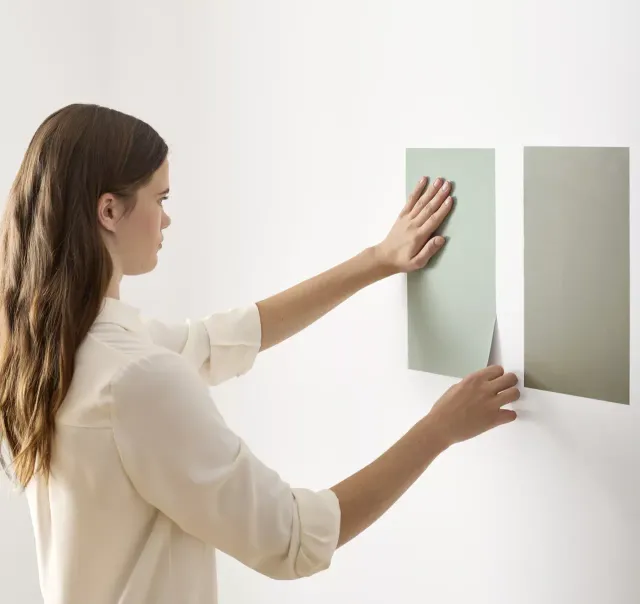
Use the visualizer to narrow your shortlist, then confirm the finalist on your actual wall. A peel-and-stick sample of Baby Fawn, checked in morning and evening light, is the last step before a gallon.
- Made with real paint
- Delivered next day
- Peels off clean
 4.8 · 1,842 reviews