Salamander
2050-10 · Benjamin Moore


Benjamin Moore
Salamander
2050-10
Subtle blue-leaning green, a cool color
- Color family
- Green
- Sold for
- Interior and exterior
Benjamin Moore Salamander 2050-10 is a near-black teal, the last step on a strip that starts at pale aqua. Its LRV of 6 means it is dark before it is anything else, and the blue-green in it shows only where the light is strong. Our method reads it as a subtle blue-leaning green. Cabinets, front doors, shutters and paneled rooms are where it gets used.
Is Salamander warm or cool? Undertones by the numbers
leans blue-green
Undertone
Subtle blue-leaning green
A gentle lean, quiet on the wall.
Measured, Salamander carries a moderate green tipped toward blue with no warmth behind it, and that is why it reads teal rather than forest. Its own strip makes the same case: the colors above it are Waterfall 2050-50 and Florida Keys Blue 2050-40, aquas rather than greens, and Salamander is that family taken all the way down. Set it against white marble and the blue surfaces first. Set it against oak and the green does. Regent Green 2136-20 and Pacific Sea Teal 2049-10 are its nearest relatives and both push further into blue than it does.
Salamander in north, south, east and west light
North light does Salamander no favors. A cool color under cool light gives up the last of its green and the wall turns steely, so a north bedroom in it feels unheated unless there is wood or a warm white somewhere in the room. South light is where the teal is unmistakable and closest to the chip. An east room shows it at its softest first thing and colder by lunch. A west room is dull all morning and best in the last hour. Bulbs at 3000K are the safe setting, since 4000K drives it blue and 2700K drives it green.
Watch for
- Turns steely and colder than the chip in a north room with no warm finishes in it
- Reads teal in a bright kitchen and near-black in the same kitchen after dark
- Looks blue beside a true forest green and green beside a navy
Best rooms and surfaces for Salamander
Salamander belongs on surfaces people stand close to: kitchen cabinets, a bar, a bathroom vanity, a run of built-in shelves. On cabinets the teal is what registers, and it goes further with white or veined marble and polished nickel than with brass. A bedroom in it is calmer than the number implies, because a cool dark reads as distance rather than as weight, though a warm floor is needed to stop the room going cold. Across four walls of a living room it can feel severe unless the windows are large. A windowless hallway is the one place to avoid, since it simply goes black there.
Salamander on an exterior
Benjamin Moore sells Salamander for exterior use and lists it among its exterior wood stain colors too, so it lands on shingles and fencing as often as on trim. Full sun makes the teal obvious and a house in it reads as a color rather than as a dark; shade takes it to near-black. It works with white trim, gray stone and a cedar door, and it is the better pick than a warm green when the roof is gray or blue-gray.
Try Salamander on your own walls
Upload a photo of your room, or the outside of your house, and TryMyHome renders Salamander onto the walls so you can judge it in your light, with your floors and furniture. Your first five renders are free.


Trusted by 19,897+ happy homeowners
Salamander vs Essex Green, Black Forest Green, Jasper and Hale Navy
 Essex GreenSalamander
Salamander vs Essex Green HC-188
Salamander is a touch lighter; undertone subtle blue-leaning green vs noticeable green.
Essex Green HC-188 is the searched comparison, and the two sit at the same depth with opposite leans: Essex Green measures a noticeable green with yellow behind it at an LRV of 6, while Salamander pulls toward blue. On a cabinet run in daylight one looks like a hunting green and the other like a dark teal. Warm wood, brass or brick anywhere nearby will make Salamander look cold, which is the usual reason people end up choosing Essex Green.
 Black Forest GreenSalamander
Salamander vs Black Forest Green HC-187
Salamander is a touch lighter; both have a subtle blue-leaning green undertone.
Black Forest Green HC-187 is a point deeper at an LRV of 5 and holds less color, so on a sunlit door Salamander is still showing teal while Black Forest Green has already gone to black. Both are cool, which makes them hard to separate on a chip and easy on a wall. Choose Black Forest Green when the surface should sink into shadow, and Salamander when it should read as a color from a few feet away.
 JasperSalamander
Salamander vs Jasper SW 6216
Salamander is a touch lighter; undertone subtle blue-leaning green vs subtle green.
Jasper SW 6216 is the Sherwin-Williams page color nearest to Salamander, a point and a half darker at an LRV of 4 and measuring a subtle green with nothing pulling it toward blue. That is the entire difference, and it is enough: Jasper reads dark green, Salamander reads dark teal, at almost the same depth. Warm floors carry Jasper more easily. Gray tile carries Salamander.
 Hale NavySalamander
Salamander vs Hale Navy HC-154
Salamander is a touch darker; undertone subtle blue-leaning green vs subtle blue.
Hale Navy HC-154 is the black-blue set against this black-green, about three points lighter at an LRV of 8 and measuring a subtle blue. On chips they look like one idea; on a cabinet door Hale Navy is plainly navy and Salamander plainly teal. The green is what lets Salamander sit with plants, stone and marble, while Hale Navy is the easier one to match to blues a house already has.
Questions about Salamander
Is Salamander green or blue?
Green, with the blue pulling hard on it. The measurement puts it in the green family with a lean toward blue, which is why most people land on teal instead of either word. A bright kitchen shows the blue half first, and warm oak brings the green back. Benjamin Moore puts it at the foot of a strip of aquas, which is a fair account of where it comes from.
What colors go with Salamander?
Benjamin Moore's own picks beside it are Sebring White OC-137, Silver Marlin 2139-50 and White Dove OC-17: a soft white, a pale gray-green and the brand's most used off-white. White marble, polished nickel, gray stone and pale oak all sit comfortably with it. Warm brass and orange-toned wood are the risky pairings, since they make the teal look colder than it measures.
What is one shade lighter than Salamander?
Dollar Bill Green 2050-20 is the step up on its own strip, roughly three points lighter and the first version where the color is easy to read as green in an ordinary room. Newport Green 2050-30 is two steps up and no longer a dark color at all. Nothing sits below Salamander on that strip, so anything deeper has to come from another family, such as Black Forest Green HC-187.
Is there a Sherwin-Williams equivalent to Salamander?
Rookwood Shutter Green SW 2809 is the closest by measurement, near enough that most people would accept it as the same color once it is on a door. Cascades SW 7623 is next and slightly bluer. Jasper SW 6216 is the nearest one carrying a page here. Nothing at Sherwin-Williams is sold under a matching name.
Is Salamander a good bedroom color?
It can be, and it is quieter in a bedroom than its depth suggests, because a cool dark reads as distance rather than as weight. The room wants a warm floor, a warm white ceiling and lamps rather than downlights, or it goes cold. People who try it and back out usually blame a north window rather than the color itself.
Get a sample before you paint
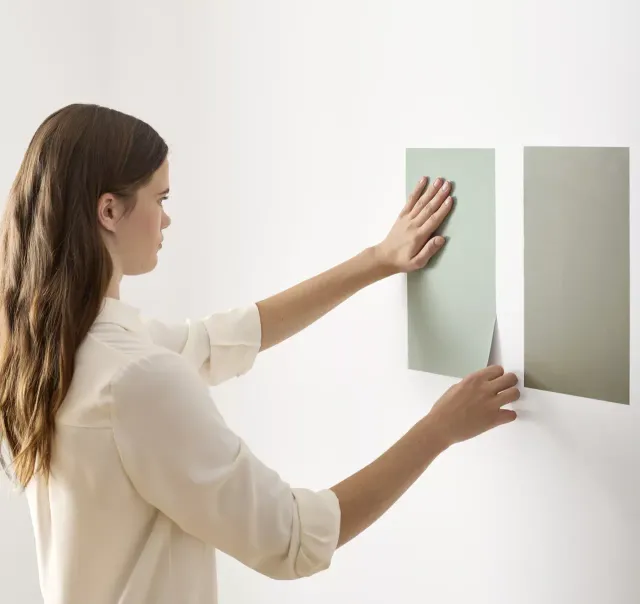
Use the visualizer to narrow your shortlist, then confirm the finalist on your actual wall. A peel-and-stick sample of Salamander, checked in morning and evening light, is the last step before a gallon.
- Made with real paint
- Delivered next day
- Peels off clean
 4.8 · 1,842 reviews