Backwoods
469 · Benjamin Moore


Benjamin Moore
Backwoods
469
Noticeable green, a green color
- Color family
- Green
- Sold for
- Interior and exterior
Benjamin Moore Backwoods 469 is a dark forest green with a gray cast, the darkest rung of its own group. Its LRV of 13 is firmly in the dark band, which makes it a statement on four walls and an easy choice on cabinets, doors and siding. Our method reads it as a noticeable green with no yellow pulling it toward olive. It turns up most on kitchen islands, built-in shelving and front doors.
Is Backwoods warm or cool? Undertones by the numbers
leans green
Undertone
Noticeable green
A visible lean you see in daylight.
The lean here is green and only green, without the yellow that makes so many dark greens read as olive, which is why Backwoods stays on the forest side even when the room is warm. Against white trim it looks like a clean deep green; against a cream white it can look slightly cool by comparison. Warm wood, brass and unlacquered hardware bring out its depth without turning it brown, and cool marble or gray quartz makes it read almost black at the edges. Boreal Forest AF-480 is the nearest color to it in the Benjamin Moore deck and is a close sibling rather than a twin, a shade lighter in feel on a door.
Backwoods in north, south, east and west light
In a north-facing room Backwoods reads at its greenest and coolest, and because there is no yellow in it to lose, it holds its color there better than an olive would, though the walls will look close to black in the corners after dusk. South and west sun lifts the surface and shows the gray sitting under the green, especially on a sheen above matte. East light gives it an hour of clear green in the morning and then lets it settle. Warm bulbs at 2700K to 3000K keep it looking like a color at night; cool bulbs flatten it toward charcoal.
Watch for
- Goes close to black under low warm lamplight in a room with one window
- Shows every roller mark on a large flat wall, so the sheen matters more than usual
- Reads cooler than expected beside a cream white such as Swiss Coffee OC-45
Best rooms and surfaces for Backwoods
Cabinets are where this color does its best work: a dark green kitchen island, a run of lowers under white uppers, a butler's pantry or a wall of built-in shelving, all of which give the green a shape rather than a whole room. Studies, libraries and dining rooms take it on four walls if there is decent daylight or plenty of lamps, and the effect is enclosing on purpose. Interior doors, a mudroom bench and a bathroom vanity all suit it. It is a poor choice for a small bathroom with no window, where it will read black, and for a ceiling in any room under a normal height.
Backwoods on an exterior
Benjamin Moore sells Backwoods for exterior use, and outside is where the name earns itself, on a house set among trees where the siding is meant to recede. Full sun raises the gray in it and can make a south wall look lighter and duller than the sample, while shaded elevations keep the deep green. It works as whole-house siding with white trim, on shutters against a cream house, and on a front door or garage doors where the green reads clearly at close range.
Try Backwoods on your own walls
Upload a photo of your room, or the outside of your house, and TryMyHome renders Backwoods onto the walls so you can judge it in your light, with your floors and furniture. Your first five renders are free.


Trusted by 19,897+ happy homeowners
Backwoods vs Vintage Vogue, Pewter Green, Rosemary and Dark Olive
 Vintage VogueBackwoods
Backwoods vs Vintage Vogue 462
Backwoods is a touch lighter; undertone noticeable green vs noticeable yellow-leaning green.
Vintage Vogue 462 is the color people search against this one, and the two are nearly the same depth, an LRV of 12 against 13. The difference is the lean: Vintage Vogue carries some yellow in its green and Backwoods carries none, so Vintage Vogue looks slightly warmer and more olive in a warm room. Backwoods is the safer pick where the finishes are cool and you want the green to stay a forest green.
 Pewter GreenBackwoods
Backwoods vs Pewter Green SW 6208
Backwoods is a touch lighter; undertone noticeable green vs subtle yellow-leaning green.
Pewter Green SW 6208 is a point darker at an LRV of 12 and much grayer, with only a subtle lean where Backwoods has a clear one. On cabinets Pewter Green reads as a gray-green that could pass for a neutral, while Backwoods reads as green first. Choose Pewter Green if the sample of Backwoods looked too much like a color; choose Backwoods if the gray-greens looked like mud.
 RosemaryBackwoods
Backwoods vs Rosemary SW 6187
Backwoods is a touch darker; undertone noticeable green vs noticeable yellow-leaning green.
Rosemary SW 6187 sits at almost the same lightness, an LRV of 14, and takes its green toward yellow, so the two are a warm and a cool version of one idea. Under lamplight Rosemary goes toward olive and Backwoods holds its green. If the room already has honey oak or brass in quantity, Rosemary will blend with it and Backwoods will stand against it.
 Dark OliveBackwoods
Backwoods vs Dark Olive 2140-30
Backwoods is a touch darker; undertone noticeable green vs noticeable yellow-leaning green.
Dark Olive 2140-30 is a shade lighter at an LRV of 14 and holds less color, which turns it into the brown-green it is named for. Set beside it, Backwoods looks like a clear green and Dark Olive looks like a green that has been through mud. Dark Olive suits rooms with leather, walnut and warm stone; Backwoods suits white paint, black metal and glass.
Questions about Backwoods
Does Backwoods look black at night?
It gets close in a room lit only by a lamp or two, though a warm bulb keeps enough green visible to tell it apart from a true black. Daylight is where the color lives. If you want a dark green that stays readable in the evening, a sheen above matte on cabinets or doors helps more than changing the color.
Is Backwoods a good kitchen cabinet color?
Yes, and dark green cabinets are its most common use. At this depth the doors keep their panel shadows and the color sits well with white counters, brass or black hardware, and oak floors. A full kitchen of it is heavy in a room with one window; the usual answer is dark lowers or an island with lighter uppers above.
Does Backwoods work on a front door?
It does, and a door is one of the easiest places to use it because the color is seen against the house rather than around you. On a white or cream house it reads clearly green in daylight and nearly black at dusk. Benjamin Moore rates it for exterior use, so the same can holds for shutters, a porch ceiling or garage doors.
Which Sherwin-Williams green comes nearest to Backwoods?
Rookwood Dark Green SW 2816 is the closest by measurement, a close sibling rather than a twin, and it is slightly darker. Rosemary SW 6187 is the nearest color with its own page here, warmer and yellower. Pewter Green SW 6208 gets named as a substitute more often than it deserves, since it is a good deal grayer.
What colors go with Backwoods?
Benjamin Moore's own picks are White Dove OC-17, Dune White 968, Fieldstone 1558 and Boothbay Gray HC-165, which cover a soft white, a warm white, a mid taupe-gray and a cool blue-gray. The blue-gray is the interesting one, since it keeps the scheme from being green and white alone. Oak, walnut, brass and black metal all suit it.
What is one shade lighter than Backwoods?
Cambridge Green 468 is the next rung up its own group at an LRV of 21, a mid-depth green that still reads clearly green rather than dark. High Park 467 at 30 is the step after that and moves into sage territory. Among its close matches, Holiday Wreath 447 is only a shade lighter if you want a small change.
Get a sample before you paint
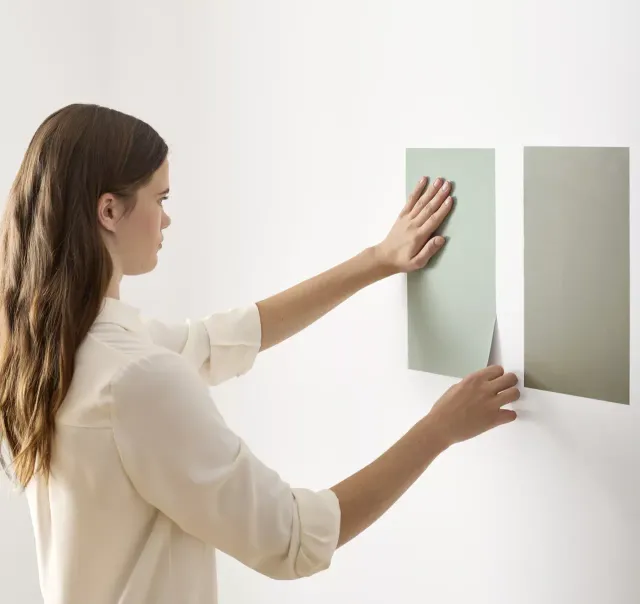
Use the visualizer to narrow your shortlist, then confirm the finalist on your actual wall. A peel-and-stick sample of Backwoods, checked in morning and evening light, is the last step before a gallon.
- Made with real paint
- Delivered next day
- Peels off clean
 4.8 · 1,842 reviews