Antique White
SW 6119 · Sherwin-Williams


Sherwin-Williams
Antique White
SW 6119
Noticeable yellow-beige, a warm color
- Color family
- White
- Sold for
- Interior and exterior
Sherwin-Williams Antique White SW 6119 is an ivory cream with a clear, visible yellow lean, more cream than white on any wall. Its LRV of 73 keeps a room bright, and the yellow is strong enough that the walls read as cream even beside a cream trim. Our method reads it as a noticeable yellow-beige, warm with no pink in it. It is a kitchen cabinet color first, the classic cream for a traditional kitchen, and a wall color for rooms with dark wood.
Updated
Is Antique White warm or cool? Undertones by the numbers
leans yellow
Undertone
Noticeable yellow-beige
A visible lean you see in daylight.
Antique White measures as a clear yellow with a trace of red, noticeably more yellow than Creamy SW 7012, its listed trim white. That is enough for the yellow to show in every room, not only by contrast. Beside a crisp white such as Pure White SW 7005 the walls look plainly yellow; beside Creamy they look like the deeper cream. Dark wood, brick and brass absorb the yellow and the walls read as a warm ivory. Gray tile, chrome and cool quartz make it look like butter. Navajo White SW 6126 is its twin, the same color under another name. Muslin SW 6133 is a touch lighter with the same yellow. Aged White SW 9180 is lighter and grayer, a cream with the yellow turned down.
Antique White in north, south, east and west light
Antique White is a strong pick for a north-facing room, where its yellow does what the light will not. The walls read as a warm ivory instead of the gray that lighter whites turn there. The room feels lit even on a dull day. South light is the exposure to watch, since by afternoon the walls go plainly yellow. East rooms get the cream at breakfast and hold most of it; west rooms turn toward gold at sunset. Bulbs at 2700K push it toward butter, 3000K keeps it near the chip, and 4000K bulbs make it look sallow.
Watch for
- In a bright south room the walls go plainly yellow by afternoon
- Beside gray tile, chrome or a cool quartz it reads like butter
- Under 4000K bulbs it looks sallow rather than cream
Best rooms and surfaces for Antique White
Antique White is a cabinet color first, and the kitchen question below covers that. On walls it belongs in traditional rooms: a dining room with dark wood, a study with cherry shelves, a hallway with oak trim. Its yellow gives a north-facing bedroom a warm glow that a paler white cannot. It is a poor whole-house color in a modern house, where it reads as an old cream that was never repainted. It is a poor pick for a bathroom with white or gray tile, where it turns yellow. With cream tile, brass and a wood vanity it works. On an accent wall it looks like a mistake, so use it on every wall or none.
Antique White on an exterior
Antique White is sold for exterior use. On siding in full sun it reads as a warm cream with a little of the yellow burned off. In shade the ivory holds and the house looks warm rather than white. It suits brick, stone, a brown roof and a traditional house with shutters. Creamy SW 7012 on the trim keeps the pairing soft; Pure White SW 7005 gives crisper lines but brings out the yellow. A door in Pewter Green SW 6208 or Urbane Bronze SW 7048 sets it off.
Try Antique White on your own walls
Upload a photo of your room, or the outside of your house, and TryMyHome renders Antique White onto the walls so you can judge it in your light, with your floors and furniture. Your first five renders are free.


Trusted by 19,897+ happy homeowners
Antique White vs Alabaster, Aged White, Creamy and Natural Linen
 AlabasterAntique White
Antique White vs Alabaster SW 7008
Antique White is noticeably darker; undertone noticeable yellow-beige vs subtle yellow-beige.
Alabaster SW 7008 is ten points lighter at an LRV of 82 and carries a fraction of the yellow. Alabaster reads as a warm white and Antique White as a cream, and the two never look like the same color on a wall. Pick Alabaster for a bright kitchen or a whole house that should read white. Pick Antique White for a traditional room, a glazed cabinet finish or a north room that needs real warmth.
Antique White vs Aged White SW 9180
Antique White is a touch darker; both have a noticeable yellow-beige undertone.
Aged White SW 9180 is two points lighter at an LRV of 74 and grayer, a cream with the yellow turned down. Beside Antique White it looks like a putty cream; beside Aged White, Antique White looks like ivory. Choose Aged White for a modern room where a plain cream would look dated. Choose Antique White where the yellow is wanted, with dark wood, brass and brick.
 CreamyAntique White
Antique White vs Creamy SW 7012
Antique White is noticeably darker; undertone noticeable yellow-beige vs subtle yellow-beige.
Creamy SW 7012 is nine points lighter at an LRV of 81 and is the trim white Sherwin-Williams lists for Antique White. It is a pale cream with a small yellow lean; Antique White is a deeper cream with a clear one. Used together they give a room one warm family, Creamy on trim and Antique White on walls or cabinets. As alternatives, Creamy is the pick for walls and Antique White for cabinets.
 Natural LinenAntique White
Antique White vs Natural Linen SW 9109
Antique White is noticeably lighter; both have a noticeable yellow-beige undertone.
Natural Linen SW 9109 is six points darker at an LRV of 66 and is a tan-beige with a touch of red. Antique White is a yellow cream. Beside each other Natural Linen looks like a soft greige and Antique White like ivory. Take Natural Linen for walls that should read as a neutral beige. Take Antique White for walls that should read as cream, and for cabinets.
Questions about Antique White
Does Antique White look yellow?
Yes, and it is meant to. It has a clear yellow lean, more than Creamy SW 7012 or Alabaster SW 7008, so it reads as a yellow ivory in most rooms. The yellow is loudest in south sun, under 2700K bulbs and beside gray or crisp white. It is quietest beside dark wood, brick and brass, where it settles into a warm ivory. Choose it for the yellow, not in spite of it.
Is Antique White good for kitchen cabinets?
Yes. It is the classic cream cabinet color and still the best fit for a traditional kitchen with a glazed or distressed finish. It suits brass and oil-rubbed bronze hardware, a wood or dark granite counter and a cream or travertine backsplash. Against white quartz, gray tile or stainless steel it reads yellow and dated. Give it walls in Creamy SW 7012 or Alabaster SW 7008 so the cabinets are the deeper cream.
Is Antique White a good trim color?
As a trim color it works under deeper warm walls. A tan such as Natural Linen SW 9109, a green such as Clary Sage SW 6178 or a red-brown all suit it. Under white or gray walls it looks yellow and dirty. It is also a common ceiling color over warm walls, where its yellow keeps the ceiling from reading gray. Under cool walls, Extra White SW 7006 is the trim to use.
What colors go with Antique White?
Sherwin-Williams gives it Creamy SW 7012 for trim and ceilings. Its accents are Whole Wheat SW 6121 and Fallen Leaves SW 9114, a wheat tan and a deep brown. Beyond that it suits cherry, walnut and stained oak, brass, brick and terracotta. A deep green such as Pewter Green SW 6208 or a navy such as Naval SW 6244 holds against it on an island.
What is one shade lighter or darker than Antique White?
On its fan-deck strip the next step lighter is Muslin SW 6133, two points up with the same yellow. Polar Bear SW 7564 sits at the same lightness, a touch grayer. The next step darker is Chopsticks SW 7575, eight points down and a true tan. Among its closest matches, Navajo White SW 6126 is the twin, the same color under another name.
Get a sample before you paint
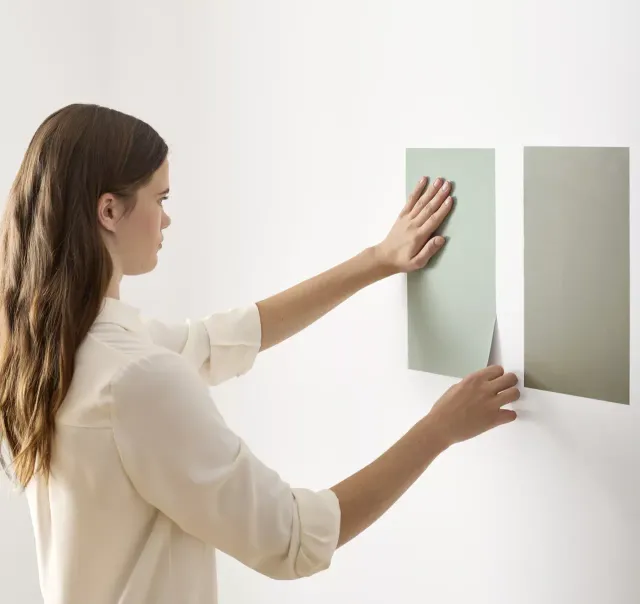
Use the visualizer to narrow your shortlist, then confirm the finalist on your actual wall. A peel-and-stick sample of Antique White, checked in morning and evening light, is the last step before a gallon.
- Made with real paint
- Delivered next day
- Peels off clean
 4.8 · 1,842 reviews